

| Practical thread strength analysis |
▶ View photo: stripped bolt threads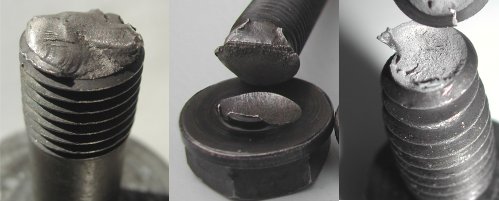 |
| Pitch P, angle of thread 60º, pitch diameter d2=D2, major diameter of external thread d, minor diameter of internal thread d3, major diameter of internal thread D, minor diameter of internal thread D1, root radius R, height of fundamental triangle H. |
| The critical areas of stress of screwed fasteners are: the effective cross section area (tensile area); the shear area of the external thread (screw, bolt); the shear area of the internal thread (nut, tapped hole). When a reliable design is to be achieved, screw joints are designed so that the effective cross section area is determinative for the strength of the assembly — i.e. the screw fails rather than the internal or external thread strips. |
| The length of the screw engagement should at least be sufficient to carry the full load necessary to break the screw. If not, thread stripping starts at the first engaged thread and successively shears off subsequent threads. This may take some hours to complete, so the joint may appear fine at the time of assembly but will fail in service. |
| The size of a screwed fastener is first established by calculating the required tensile area with the appropriate factor of safety. If the joint is fixed using a nut and bolt of the same grade there is no need to size the nut, since the standard nut length is such that the screw will fail before the thread is stripped. If the screw fastens into a tapped hole of a lower-strength material, a check of the thread engagement length is required. |
| The shear strength is defined by Fs=τ·Ath, where τ is the shear strength of the material and Ath the thread shear area. When the external and internal thread are of the same material, the internal thread (in the tapped hole) is stronger in shear than the external thread. One of the problems in predicting the thread-stripping strength is that, without considering effects such as thread bending, nut dilation (radial displacement) and tolerances of thread dimensions, an optimistic result is calculated. Accurately calculating the required thread engagement length is a complex problem; rigorous and extensive tests can be used to measure the strength of a range of engagement lengths. |
| In this way the length of engagement Le=0.75d of a standard nut is defined (standard nut height 0.8d > 0.75d because of the chamfered hole). The shear strength of a material is often expressed as the ratio of shear to tensile strength; for ductile materials like steel τ/σ=0.580. With a bolt and nut of the same grade, the ratio Ath/As should exceed 0.580 to ensure the tensile area remains the weakest link. A material with only half the shear strength of the fastener requires double the length of engagement, Le=2×0.75d. Weak materials are also sensitive to galling at high contact pressure — helicoils can be used to increase the stripping strength while preventing galling. |
| Case: effective length of thread engagement. Problem: calculate the required length of engagement of a tapped hole in a casting of spheroidal graphite cast iron. The thread strength must be able to carry the full load at which an M12-10.9 bolt fails. |
| Given: the tolerance class of the dimensions of a standard nut is assumed representative for the tapped hole. The ratio of shear strength to tensile strength of the SG cast iron is taken as τ/σ=0.9, where the tensile strength is σ=500 MPa. |
| Solution: the ratio of shear strength of the bolt and the tapped hole is (0.58×1000)/(0.9×500)=1.3. The required length of thread engagement becomes 1.3×0.8d=12.5 mm. A practical calculation method for the thread stripping strength is given by Ath=0.5πd0L0, where d0=(d2+d3)/2 — applying this formula gives an effective length of thread engagement of L0=11.5 mm. Note that the shear strength of a metric fine thread exceeds that of a standard metric thread because of the slightly larger d0 value (approximately 6%). |
Design considerations of reliable screw joints
Why a reliable screw joint is designed so the screw fails before the thread strips, how the standard nut height (0.75d effective engagement) follows from the shear/tensile strength ratio, and a worked example.
By Anton van BeekRead in Dutch
Migrated from /calculators/stripping.htm. Technical content preserved; presentation modernized.