
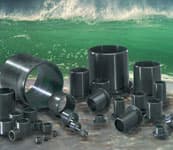
Water-lubricated journal bearing
PV-value, side-leakage flow, power loss and frictional temperature rise of a water-lubricated journal bearing operating at near-full eccentricity, assuming adiabatic conditions.
Bearing length number, L/D1.21
PV-value0.4 MPa·m/s
Flow number, C_q0.725
Power loss, N = μF·2πn/601707.14 W
Side leakage, Q109.722
Frictional heating, ΔT13.4 K
The legacy source also has a Viscosity, η field, but never uses it in the PV-value, side-leakage, power-loss or heating formulas — confirmed against the original waterlub.js, which reads it from the form and never references it again. It has zero effect on any result, so it is not exposed as an input here.
Method & references
- Water-lubricated bearings operate at near-full eccentricity (ε=0.999 assumed) because of water’s low viscosity.
- Frictional heating assumes adiabatic boundary conditions: power loss N is drained by the natural side leakage Q (plus any forced flow) when submerged.
- Flow through the bearing can be improved with axial grooves (forced flow via an applied pressure difference) — see the hydraulic diameter calculator.
The computation is a literal port of the original client-side JavaScript from /calculators/waterlub.htm. Results are verified equal to the original by an automated golden-master test. No formula has been re-derived or “improved”.