

Cone-type shaft-hub interference fit — fixed 20mm mean diameter
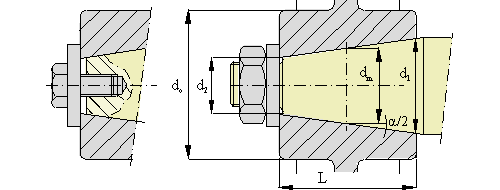
Interference, contact pressure, friction force, axial force and transmission torque for a cone-type shaft-hub connection (Lame equations), with the mean diameter fixed at 20mm as in the original locked demo page.
Stresses
The legacy "please login" demo lock froze the mean diameter d_m to 20 mm (also the page's own default). Every other input (bore/outer diameters, length, cone ratio, axial displacement, friction, moduli, Poisson ratios) was already free to vary under the lock and remains free here. The interference should be corrected for surface roughness (10%·2·(Rz1+Rz2), Rz≈6Ra per ISO 6336-2). Assumes stresses stay below the elastic limit. Independently of the diameter lock, if the entered bore/outer diameters are physically invalid relative to the fixed mean diameter (outer diameter smaller than the bore, or a negative bore), the legacy source silently discards both and substitutes its own defaults (dᵢ=20 mm, dₒ=80 mm) — note this replaces even a deliberately solid shaft (dᵢ=0, the page's own default) with a 20 mm bore — rather than rejecting the input, preserved exactly, with no separate output showing the diameters actually used. Separately, entering dₒ=0 is a supported special case (unlike the reset above) — the legacy source treats it as an effectively infinite outer diameter (a very thick hub with no defined outer boundary), substituting a large finite stand-in value rather than 0 itself; this is not indicated in the field label.
Method & references
- Lame’s equations for thick-walled cylinders (elastic regime), applied to a cone-type shaft-hub connection.
- Self-locking: Ff = Fp when µ = tan(α/2) = (d1−d2)/(2L) = C/2. Self-locking connections typically use C = 0.1..0.2; cone clutches (designed NOT to jam) use C > 0.2.
- FIXED GEOMETRY: mean diameter d_m = 20 mm — the original login gate forces this value regardless of input; see notes.
The computation is a literal port of the original client-side JavaScript from /calculators/c5_16.htm. Results are verified equal to the original by an automated golden-master test. No formula has been re-derived or “improved”.