

Interference fit — pressure, force, torque and assembly temperature
Contact pressure, friction force/torque and stresses for an interference fit (Lame equations), plus the cooling/heating temperature needed for expansion/shrink-fit assembly.
Stresses
Assembly temperature
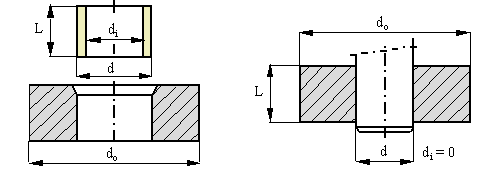
Unlike the sibling press-fit calculator (e3_8), this page takes the diametral interference ratio δ/d directly as an input rather than deriving it from δ and d, and adds an independent assembly-temperature calculation for cooling the inner part / heating the outer part to reach a target mounting interference. If the entered geometry is physically invalid (interface diameter or outer diameter smaller than the bore, or a negative bore), the legacy source silently discards all three diameters and substitutes its own default set (dᵢ=20 mm, d=23 mm, dₒ=80 mm) rather than rejecting the input — preserved exactly. There is no separate output showing the diameters actually used, so an invalid combination is not obviously flagged in the results. Separately, entering dₒ=0 is a supported special case (unlike the reset above) — the legacy source treats it as an effectively infinite outer diameter (a very thick outer part with no defined outer boundary), substituting a large finite stand-in value rather than 0 itself; this is not indicated in the field label.
Method & references
- Lame’s equations for thick-walled cylinders (elastic regime).
- Default values represent a polymer bushing, steel hub.
The computation is a literal port of the original client-side JavaScript from /calculators/e6_2.htm. Results are verified equal to the original by an automated golden-master test. No formula has been re-derived or “improved”.