

Probabilistic radial clearance of a hydraulic cylinder wear ring
Probabilistic (1% percentile) and worst-case deterministic radial clearance of a hydraulic cylinder wear ring, from the piston, groove and ring-thickness tolerance ranges.
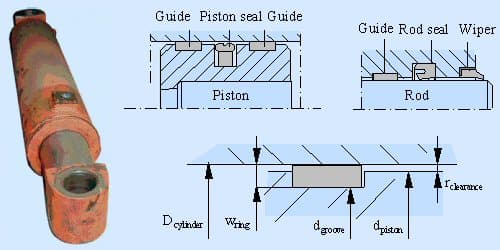
Piston diameter, mean299.75 10⁻³ m
Piston diameter, σ0.08333333333333333 10⁻³ m
Groove diameter, mean294.75 10⁻³ m
Groove diameter, σ0.08333333333333333 10⁻³ m
Ring thickness, mean3 10⁻³ m
Ring thickness, σ0.03333333333333336 10⁻³ m
Radial clearance, mean0.5 10⁻³ m
Radial clearance, σ0.06770032003863302 10⁻³ m
Radial clearance, 1% percentile, min0.342258254309985 10⁻³ m
Radial clearance, 1% percentile, max0.657741745690015 10⁻³ m
Radial clearance, worst case, min0.15000000000000568 10⁻³ m
Radial clearance, worst case, max0.8499999999999943 10⁻³ m
The worst-case deterministic clearance (min/max combining extreme tolerances) is much larger than the 1% probabilistic percentile — the probabilistic approach allows a smaller nominal clearance for the same contact risk.
Method & references
- r_clearance = d_groove/2 + w_ring − D_piston/2.
- Each dimension is assumed normally distributed within a ±3σ tolerance interval (σ = (max−min)/6).
- 1% percentile uses z=2.33 on the combined (error-propagated) clearance distribution.
The computation is a literal port of the original client-side JavaScript from /engineering-abc/calculators/c1_1a.htm. Results are verified equal to the original by an automated golden-master test. No formula has been re-derived or “improved”.