| STRIBECK CURVE |
 |
| Lubrication conditons |
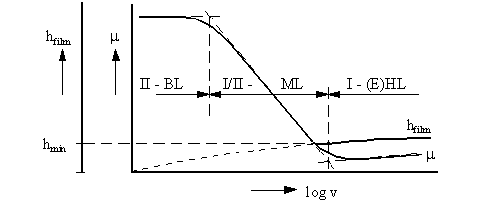
| II Boundary Lubrication If the speed is very low there will be no pressure build up in the lubricant at all and hence the loading is for 100% carried by the asperities in the contact area, protected by adsorbed molecules of the lubricant and/or a thin oxide layer. Characteristic for boundary lubrication is the absence of hydrodynamic pressure. Dry contact is excluded from boundary lubrication. |
| I/II Mixed Lubrication A hydrodynamic pressure is build up in the lubricant when the speed increases. Characteristic for mixed lubrication is that the loading is carried by a combination of the hydrodynamic pressure and the contact pressure between the asperities of both surfaces. It is the intermediate region between boundary lubrication and hydrodynamic lubrication. |
| I (Elasto)Hydrodynamic Lubrication At high speed the hydrodynamic pressure increases such that the surface asperities are completely separated by a lubricant film. Characteristic for hydrodynamic lubrication is that the load and hydrodynamic pressure are in equilibrium. Aquaplaning, where a thin water film separates the tyre and the road is a widely known example of elastohydrodynamic lubrication. |
| Running in |
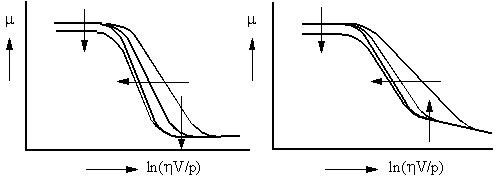 |
| left: Stribeck curve low contact pressure (dispers contact in journal bearing) right: Stribeck curve high contact pressure (concentrated point or line contact) The arrows direct the effect of running in. Optimal running in conditions are located beyond the BL - ML transition. Most asperities in the contact area are in contact and well lubricated. |
| Transition diagram |
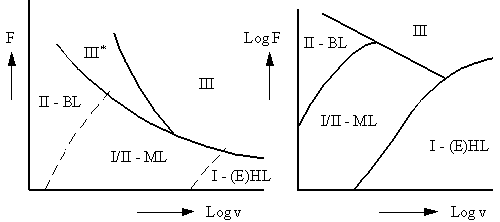 |
| To investigate lubricant additives, surface treatments and coatings the transition diagram is favourable. In this diagram, the region is visible where adhesion occurs (III) |
The Stribeck curve vs the transition diagram
The Stribeck curve and how it relates to the lubrication regimes and the transition diagram.
By Anton van Beek
Migrated from /engineering-abc/abc/stribeck.htm. Technical content preserved; presentation modernized.